Thursday, October 27, 2011

Brooke's Visit

Noah's Mom Brooke, is a community helper who teaches teachers how to teach people who are blind. Brooke visited our PreK classroom and talked about what the word disability means. We learned that a disability is "when your body is a little different and that people with disabilities do things a little differently than other people." We learned that blind people use their hands in many more ways than people who have their eye sight."
We talked about what it may feel like to be blind and Brooke had an activity for the children to participate in that may help them get a better sense of being blind. Brooke explained that bind people use their hands to gets lots of information and by touching and feeling things they are better able to learn about the world. We played a game where the children closed their eyes and reached into a bag that was filled with various objects and tried to guess what the object was.

Our Pre K children had prepared extensively for Brooke's visit and we had the opportunity to ask several of the questions that were generated the day before. ( blog: Learning Emerging Through Thoughtful Discussions).
"How can blind people read?" was a question asked and this led our discussion in the direction which explored braille : braille writers , braille stories, letters of the alphabet.

Brooke read Thingamagjig by Suzette Wright which is a braille reader where the story is in both English and braille. We learned that the pictures in braille readers are raised and can be identified by touching them and using your hands. A blind person using both hands to read a book; one hand is the guide and the other hand is the reader.
The braille writer is a machine that is used to write letters in braille. Both hands are used to push the keys and make "dots"which is actually the letters of the alphabet. We all had a chance to try the braille writer machine and Brooke wrote each of our names in braille for us to take home!

Our names felt like little dots and it was really cool to feel what our would feel like rather than
what our names would look like.

This visitation about being blind, lifted the children's awareness and it was fascinating to observe how the children were working very hard to identify and 'feel' what it really feels like to be blind. These sensitive experiences in the classroom help for children to develop compassion and empathy.

The children were very invested in all of the morning experiences and were eager to ask more questions and seemed to want to continue exploring the materials that Brooke brought into our classroom. " How do blind people get around if they do not have a guide dog?"," How does a guide dog know where to go ?"

We knew that Brooke was returning to visit again the next day and the children had absolutely become more comfortable and seemed so open and truly interested in their learning.


Police Officer Nigel Visits PreK


Sania's Dad, Nigel, visited with our class to talk about his job as a police officer. Sania was so excited to have her Dad at school and the children were truly fascinated with all of Nigel's cool tools of the trade!

The children learned lots of important information about Nigel's uniform. We learned that every officer has a special number on his badge and hat and that number identifies who he is. All police officers must wear their uniforms at all times when they are working to help the community.

Nigel carries several pieces of his police gear on his belt. Only he is allowed to use the items he needs to help people stay safe.

Nigel has a special key he uses to lock the handcuffs on and off a person when he needs to use them to help people stay safe.


Sometimes Nigel wears his police officer hat and sometimes he needs to have more protection and must wear his police officer helmet. We learned that police officers are helpers of our community. Whenever we have a problem, a police officer can always figure out a way to help! We talked about how you become a police officer and the children asked several important questions at the closing of Nigel's presentation. Nigel read two wonderful books about safety.

The visit was wonderful and the children gained so much insight into the role of a police officer having this very personal experience. The pride and joy on Sania's face was so beautiful to see... having family members share in the children's life at school builds very special connections.


Wednesday, October 26, 2011

Learning Emerges Through Thoughtful Discussion

As our study of community has evolved, we find ourselves in the wonderful place where we are fortunate to have several PreK family members join our class to share careers and talk about how their jobs are those of a community helper. We know that learning is most meaningful for children when they are fully engaged and involved and we were excited to connect our learning with our family members. Active participation, emotional investment and direct contact are all such powerful components in creating healthy , rich learning experiences. Our 'call' to all those in our community to help support our learning by visiting with our children has been amazing ! Family members and friends have graciously volunteered to share their work and connections to the community with our children. This outreach is such an important aspect of the children's learning in supporting the home and school connection. Family involvement in the classroom is a wonderful model for children experience first hand the richness of the home and school relationship.

We realized that our first order of work was to think about how we would prepare our children for the many visits that we would be hosting. What types of skills will our children be developing and practicing when a visitor shares in our classroom? How can we make the learning meaningful? The questions continued to fill our adult conversations and we brainstormed our ideas to help us look at this more clearly. We soon realized that we were looking at two distinct areas of thought on the topic of what is really happening when we invite a visitor into the classroom.

The following is a glimpse of our thoughts as we brainstormed the topic of' skills and learning experiences we anticipate the children may have when a community helper visits our classroom...

Language skills: expressive language: learning to ask a question;
receptive language skills, following directions
vocabulary skills
listening skills
comprehension skills
Cognitive skills
Social skills : how do we make a visitor feel welcome;taking turns asking question; working as a group ; respecting new materials
social and emotional joy that children glean when a family member shares with a child's class at school
Learning About Jobs In The Community .....the list goes on and on.....

We decided that we would prepare the children for each visit by leading a discussion which supports so many important thinking and language skills. The umbrella question would be for the children to think about questions they may have for the visitor and to focus on things they may be wondering. An important step in this process is to record the children's ideas which helps support the relationship between written and spoken language. The questions facilitate responsible conversation during a visit as well as become useful tools in reflecting and recalling after a visit.
A sample of what this process looked like when we had a discussion prior to one of our first few visits is as follows:

Noah' mom Brooke is a professor who teaches teachers how to teach people that are blind. Our plan was that she would visit on one day, and the following day she would return and visit with one of her blind students and guide dog who would also share with the class .

What are some of the things you are wondering ...
How do they brush their teeth?
How will the know where their bed is?
How do people get blind? How do people who are blind know how to read?
Can blind people ride a bike?
How can blind people see what they are painting?Can blind people be artists?
How can blind people see if it's day or night?
If you are a PreK child that's blind, do they go to school?
Can blind kids play sports?
How do they play baseball?
can blind people open their eyes?
How do they drive?
If you look at too much light will you go blind?
Do seeing eye dogs help blind people lead the way?
How do blind people eat their food?
How do they know where to move?
How will blind people know where their clothes are ?


This activity reminded us of how much learning and development emerges when quality time is allocated in the classroom for thoughtful discussions. We will use the ideas and questions that were generated to further guide the direction of our study.

Monday, October 24, 2011

Building Community in Lower School


Building community and developing meaningful relationships continue to be an important 'theme' running through our PreK curriculum. As the children have become much more comfortable and connected to each other in our Prek 2 classroom, the door is now wide open to the many possibilities of connecting to our larger AFS community. We recently
wrote about our visit with the 3 year old Sunflower class (see Blog - Sunflowers... Building Community) commenting on the wonderful mixed age grouping experience the children had together. When we realized the children would have another opportunity to work in a mixed age group setting with students in Lower School, we were eager to have our children participate. This past Friday was an non-numbered day on our Lower School schedule and the open time schedule allowed for so many incredible possibilities for our students of Lower School. Our faculty decided to use the day as a Day of Service Learning where children would have the opportunity to participate in a service pro
ject and /or connect with partners in learning.

Our 5th grade students are participating in a service project titled We Give Books ( www.wegivebooks.org). This service learning project combines the joy of reading with the power of helping. The book compaigne supports world literacy. Evertime the children read a book, a book is donated to organizations that work with low income children in need.
As we observed the interactions of our Prek children being read to by 5th readers, we were again reminded of the importance and genuine joy of learning that takes place when children are 'teaching' children.

Our children took leaps of faith in stretching their comfort zone in working one-on-one with a new friend from 5th grade. This was the first time that our children met the 5th graders and their confidence and growing independence was clearly reflected in their openness and willingness to participate in new activities. Conversations were overheard and the students were beginning to make authentic connections. The 5th grader's were invited to play in our classroom when their reading was over and the true joy shared of playing together was very special to see.
A second service learning project that we were involved with was creating Nature Journals with 2nd grade. Our faculty had spent an in- service day at Briar Bush and our focus was on creating outdoor learning experiences for our students. Our faculty was so inspired by this day of Professional Development focusing on Outdoor Education, that as a faculty we have attempted to bring back as many of the ideas as possible to our programs at AFS. One of the underlying messages that we all took with us was that children need to spend more time outdoors and that exploration and discovery in our natural environment is a critical component in the overall development of children. We were reminded of the need to make sure that outdoor time is fully integrated into our school days. Connecting with nature and bringing our learning outdoors may take the form of play or it may take a more focused approach. Learning experiences that facilitate development in math, language, writing and reading are areas that need not be limited to the four wall of a classroom. Hence, the teachers decided to make Nature Journals using recycled food boxes with 2nd grade. Journal writing fosters language development, pre-reading and writing skills, fine motor skills as well as creativity. Through journal writing, the children will have the opportunity to express their observation of nature through illustrations and dictations. This connection was especially exciting for a Miranda whose sister Cecily is in 2nd grade!


We gathered in our all purpose room in the basement and together the Prek class and 2nd grade worked on their Nature Journals. Again, the shared learning and social skills that our children were practicing were experiences that were wonderful to see. We plan on working on our journals outdoors with our 2nd grade friends over the next several weeks.

Alicia read The Kapok Tree which is a beautiful story about saving a tree and reflects the values of stewardship which value . Listening to a read-aloud with our new 2nd grade friends was a perfect closure to a very special time together.


Wednesday, October 19, 2011

Sunflowers Visit PreK...Building Community

Building a sense of community cross divisionally is an important component in our work of building community. The teachers of the Sunflower class (Early Childhood Division) and our PreK class have been talking about making connections and providing opportunities for the children to develop relationships by spending time together in each other's classrooms,going on walks and playing on the playground together. The Sunflowers visited our PreK classroom today and the visit was fantastic! Our PreK children were so excited to see and play with old friends and were especially thrilled to be spending time with teachers whom they knew or had in past years at AFS. Nancy and Paul were welcomed with joy and open arms by our PreK children!
Our children were warm and welcoming hosts. We had talked about what it means to help people feel welcomed and the children seemed to feel so proud of themselves in this role. We began with a circle activity where we introduced ourselves and shared something we enjoyed doing at school. It was fascinating to observe how nurturing and sensitive our children were with the younger children. We realized how important it is for children to have the opportunity to practice many of the social skills that they are developing everyday. The satisfaction on the children' faces of helping a younger child successfully build a tower was heartwarming to see and we all realized that we need to make these cross divisional connections happen more often.
We opened our classroom and the children were interested in playing in the dramatic play area, blocks, playdough, books and math center. The children shared and took turns and were helpful in showing the younger children how materials work. It seemed to really feel good for the PreK children to be the "older" kids and to be the ones guiding others.

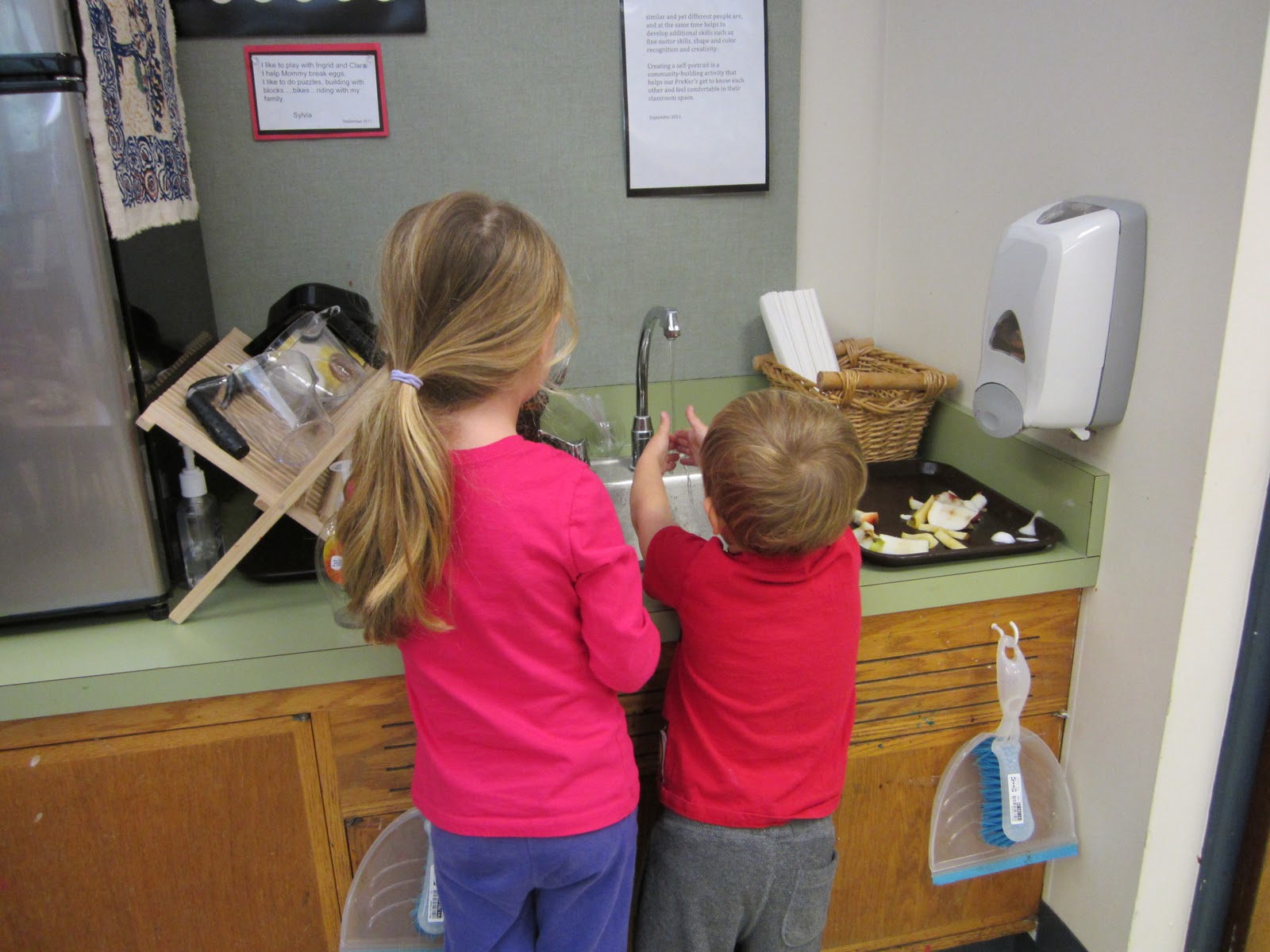
The Sunflowers were kind enough to bring cheese and crackers for snack and we had a fun smorgasbord adding fruits and pretzels to the buffet! One of our PreK children helpfully assisted as one of the Sunflowers washed their hands! The sense of pride and self confidence was quite apparent!

This experience reminded us of the value of mixed age groupings for children and of the growth and joy that comes from within.

Tuesday, October 18, 2011

Field Day Excitment

Field Day was a glorious day and the spirit of our AFS community was felt by all!  Children entered school in either blue or white tee shirts and somehow the excitement just followed the children and faculty right through the classroom doors!  The children had been preparing for this day for several weeks in gym class; practicing various relay races, large motor skills and most importantly group and team work.  This was probably the first 'real' all school event that our children had participated in.  One of the unique and very special aspects of Field Day for PreK is the cross divisional connections that the children are making with students in Upper School. Upper School students pair with our children throughout the afternoon including joining children for a  bar-b-que-lunch and assisting the children during the field events.  It is such wonderful experience to observe as the oldest members of our AFS community interact, play and get to know the youngest members of our school.   Several of the Upper School students love reflecting on the days when they were in PreK and truly embraced the time with the younger students. Enjoy the slideshow!

Monday, October 17, 2011

Bugs Outside the Box - A Science Opportunity

There's a great new exhibit at the Academy of Natural Sciences called Bugs Outside the Box that does a great job of connecting art and science.  The exhibit features an array of enormous and scientifically accurate insect sculptures by noted Italian artist Lorenzo Possenti.  The sculptures are paired with live bugs and colorful specimens from the Academy’s world-renowned invertebrate collection which makes for an exciting exhibit!